LDD-24 · Flooring Systems + Threshold Integration
One-line intent
Flooring directly supports the operational and sensory needs of each zone, with a strictly flush, zero-threshold datum across the 60' spine wall opening.System allocation by zone
| Zone | System | Reason |
|---|---|---|
| Gym (west of spine) | Poured polyurethane top coat over vulcanized rubber underlayment | Shock absorption · acoustic dampening · longevity under athletic loads |
| Living wing / ILS (east of spine) | High-density rigid-core SPC LVP with factory-attached cushion (IXPE foam or engineered cork) | Thermal stability over radiant · standing comfort · room acoustics |
| Workshop / parking / mech (south + central service) | Industrial sealed and polished concrete | Per foundation LDD; durable, cleanable, vehicle-rated |
Radiant compatibility constraints
- SPC core only. WPC and loose-lay LVP strictly prohibited (buckling + off-gassing).
- Maximum continuous slab surface temperature beneath LVP: ~85°F (manufacturer warranty threshold).
- Adhesives (if required) must be rated for continuous radiant + 20+ year VOC-free.
Spine wall threshold mandate
Zero Improvisation Rule
Gym urethane assembly (~8–10mm) is thicker than residential SPC LVP (~6–8mm).The underlying structural concrete slab must be micro-adjusted or self-leveled across the threshold of the 18'×10' glass garage door along the 60' spine wall.
Outcome: 100% flush finished floor. No T-moldings, step-ups, bevels, or trip-hazards through the spine wall opening.
⚠️ Pier foundation cascade (NEW)
Site plan confirms pier foundation (FFE 252.4). If the first floor is a wood subfloor on piers (option b in LDD-02) rather than a structural slab (option a), the entire flooring assembly stack changes. Lock foundation type before specifying urethane gym floor + LVP transitions.Open items / engineer review
- Exact assembly stack-up per zone — lock product before slab pour
- Slab elevation drop on gym side: 2–4mm lower than LVP side
- Concrete tolerance is normally ±¼" (6mm) — tighter requires self-leveling overlay
- Spine wall transition strip detail (hard butt vs flexible filler vs metal flush edge)
- Radiant control setpoint at living wing — verify ≤80°F slab continuous
- Urethane gym brand + warranty + court line painting
- SPC LVP brand + radiant compatibility statement in writing
- Polished concrete finish level (Class 1 matte vs Class 3 vs Class 4)
Cost drivers
Gym urethane (~1,800 sqft × $9–16) $16–30K · SPC LVP (~4,200 sqft × $5–10) $21–42K · Polished concrete (~2,400 sqft × $4–9) $10–22K · Self-leveling overlay at threshold $0.5–1K · Court lines $1.5–4K · Transition strip $0.5–2K. Total: $50–95K — was missing from original waterfall, now added.Air-gap concerns
- The 85°F slab cap is the most important interlock. Comfort-density radiant in cold-climate January can push slab to 90–95°F. Mechanical designer must calibrate so LVP zone never exceeds 85°F continuous. Verify in writing with LVP manufacturer.
- Self-leveling across spine threshold is a real construction sequencing challenge. Build into schedule, not "we'll do it during finish."
- Vulcanized rubber + urethane gym — pro-grade gym feel; weekend league play may feel "spongier" than expected. Set expectations.
- Polished concrete in mech room slippery when wet. Spec slip-rated finish (DCOF ≥ 0.42 wet).
- Workshop concrete + tool drops — chips show. Consider urethane cement overlay at bench main work zone (+$2.5–4K).
- Off-gassing during first 30 days — plan 14-day flush-out window with high ventilation.
- No thick rugs on heated zones — document in homeowner manual.
Cross-references
Diagram
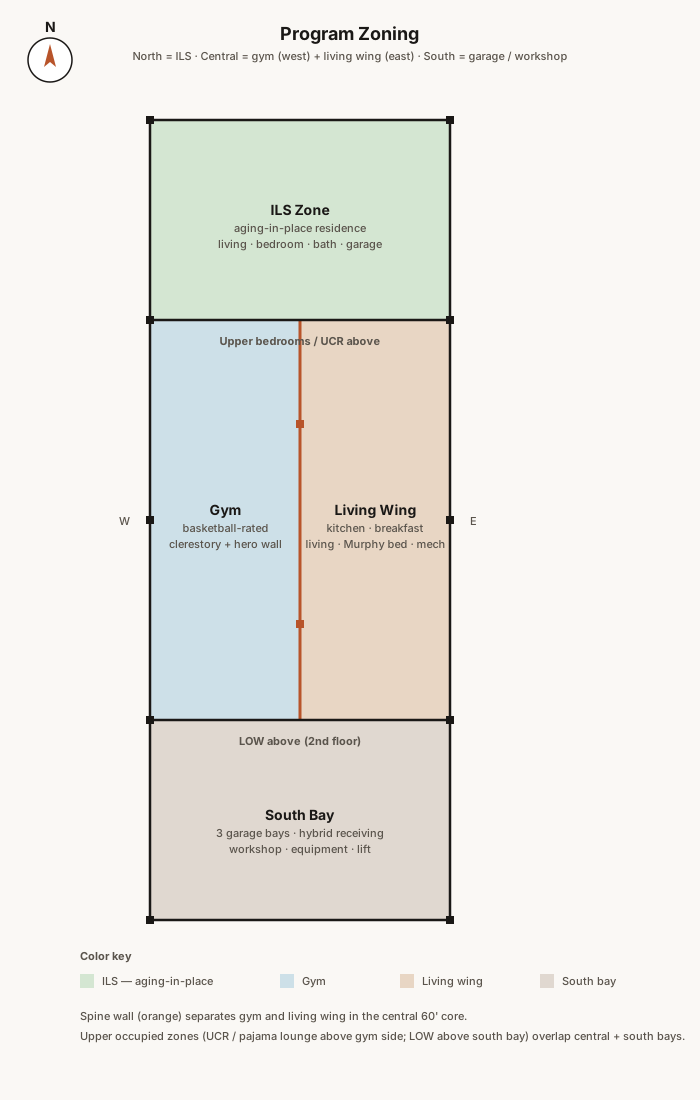
System allocation by zone — gym west (urethane) · living/ILS (SPC LVP) · workshop/garage/mech (polished concrete).