LDD-27 · Low-Cost Site-Fabricated Acoustic Cloud System
Status: 🟢 LOCKED v1.0 — Peter's spec is tight and the cost-vs-commercial argument is real. Air-gap items below are pre-construction reconciliation, especially around impact tolerance in the gym zone and the relationship to LDD-12's "no soffit" policy.
One-line intent
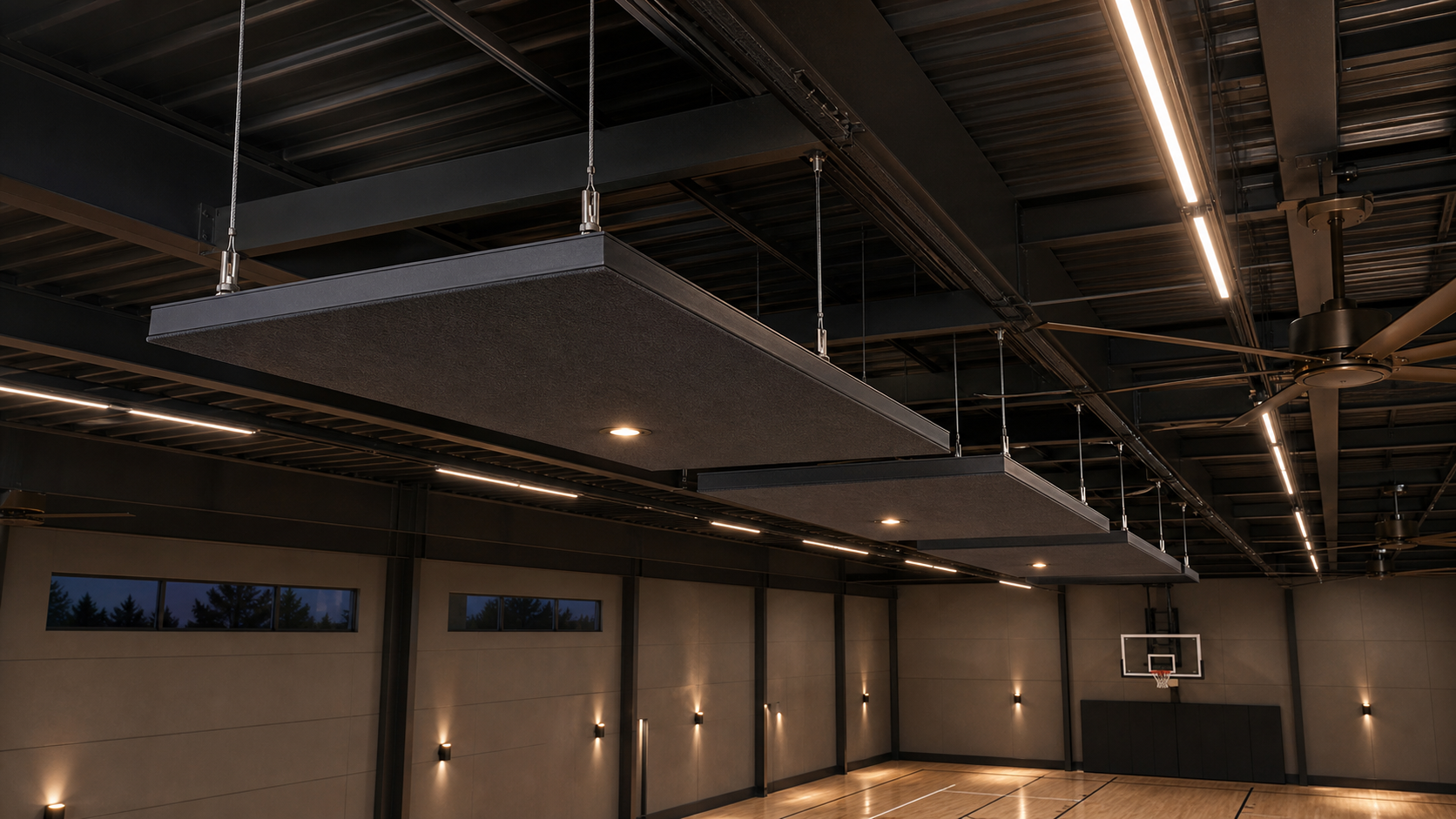
Owner-vetted, site-fabricated suspended acoustic clouds — rigid mineral wool core, exposed industrial framing, fabric-wrapped — deployed strategically over the three loudest zones (gym, social counter, mezzanine flank) rather than blanketing the whole shell.
Design intent · AI render
⚠️ STALE detail — flagged 2026-05-17. The sliver of polished hardwood athletic floor far below at the bottom edge of frame depicts the OLD spec. Per Peter's revised LDD-29 §25 the gym floor is now matte poured-urethane in medium warm-gray over rubber underlayment. Priority: LOW — the gym floor is barely visible; the cloud-to-deck relationship is the subject. Update the inline prompt's "polished hardwood athletic floor" mention to urethane and regenerate via Codex when this render is next refreshed.
Why this matters
The PEMB shell is acoustically alive — hard surfaces everywhere, 26'+ volumes, long sound paths. Without targeted absorption the gym echoes, conversation at the kitchen counter strains, and the mezzanine bleeds noise between floors. Commercial branded acoustic panels solve this at $15K+ but feel like office retrofit. Peter's site-fabricated strategy solves the same problem for materials under $3.5K and keeps the exposed-systems aesthetic intact — the clouds become part of the industrial vocabulary rather than fighting it.
This is the second deliberate exception to the project's "no soffit / exposed ceiling" rule (LDD-12). The first is the LDD-07 island cooking capture field. Recognizing it as an exception — not a violation — matters.
Locked decisions
Acoustic core
- 2" rigid mineral wool board — Owens Corning 703, Rockwool Comfortboard 80, or approved equal
- NRC 1.0 minimum at standard athletic + vocal frequencies
- Prohibited: soft fiberglass batts, open-cell polyurethane foam (sagging, degradation, weak low-frequency response)
- Module size: 4' × 8' — matches factory insulation dimensions, zero cut waste
Framing + edge detail (two options approved)
| Option | Look | Detail |
|---|---|---|
| A. Structural wood grid (warm) | 1×4 appearance-grade pine or square-edged furring face-framed into a rigid box, back cross-braced with thin tensioned aircraft wire or metal strapping | Warm, tactile, integrates with white-oak elements elsewhere |
| B. Industrial metal edge (sleek) | 24-ga galvanized drywall J-bead or aluminum U-channel, miter-cut at 45° and pop-riveted at corners | Mineral wool edge captured + protected by the metal flange |
Fabric wrap
- Heavy-duty fire-retardant matte black or dark charcoal utility/landscape fabric, industrial burlap, or unbleached canvas
- "Breathe-through" validation test: if a person can't blow air through the weave, sound can't penetrate the core
- Pulled taut over the rigid board face, wrapped around the framing perimeter with hospital corners, stapled (wood frames) or spray-adhered (metal channels) to the rear unexposed face
Suspension + air-gap (the performance multiplier)
- 1/16" stainless steel aircraft cable from PEMB roof purlins or mezzanine joists
- Adjustable quick-release grip-lock fasteners or light jack chains
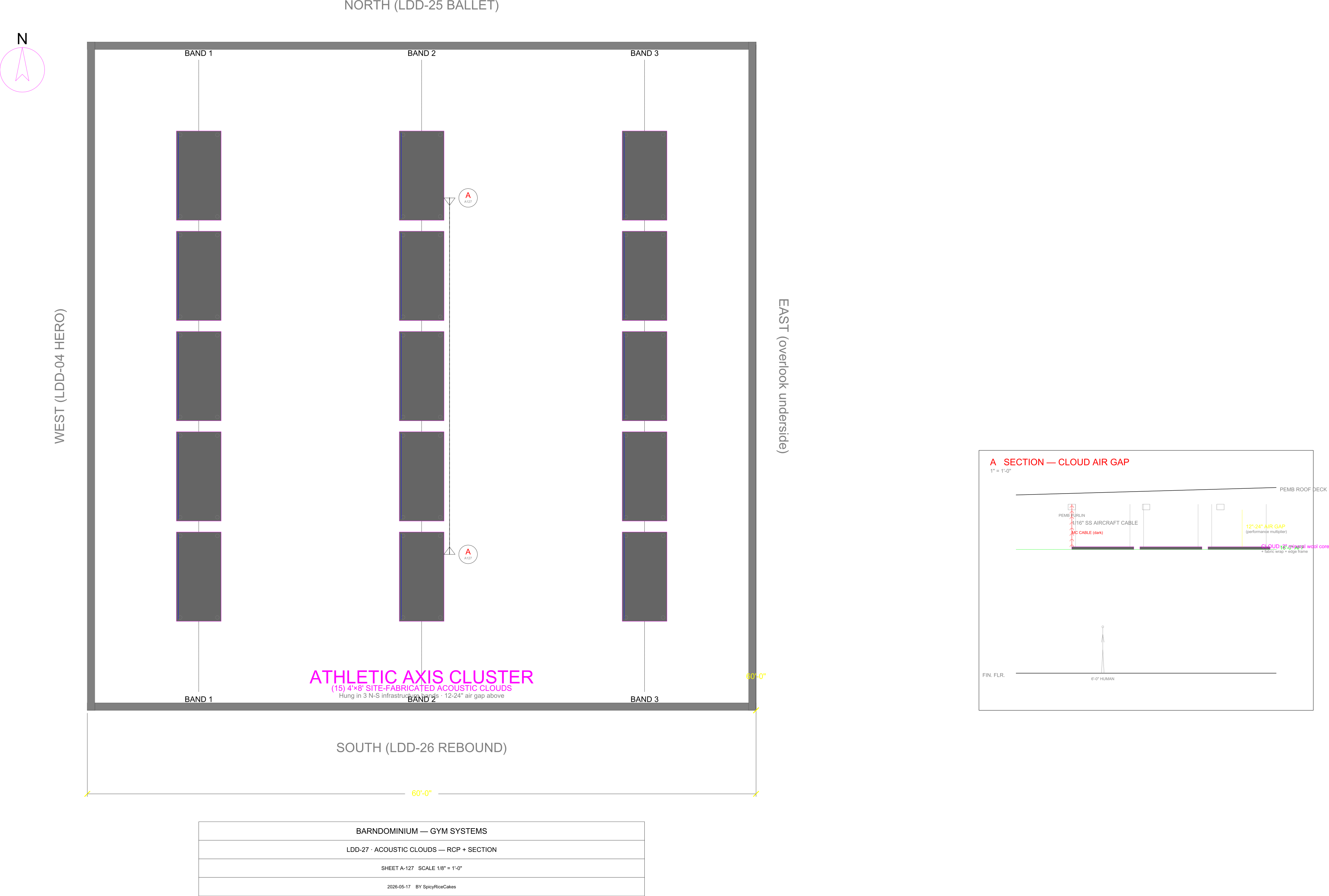
- 12"–24" continuous air gap below the structural roof deck (LOCKED)
- The air gap is the cost-multiplier: sound passes through the cloud, reflects off the deck, passes through the cloud again → near-doubled low-frequency attenuation at zero added material cost
Strategic zoned deployment (3 clusters, NOT whole-shell blanket)
| Cluster | Zone | Target |
|---|---|---|
| Athletic Axis | Gym, above net line | High-velocity vocal projection + ball-impact noise at source |
| Social Canopy | Kitchen, above LDD-20 Primary Social Counter, ~9'6" AFF | Localized intimate ceiling, isolates conversation from gym volume |
| Mezzanine Flank | Beneath living-wing mezzanine joists | Floor-to-floor sound bleed between upper habitable + lower service bays |
Lighting + conduit integration
- Where clouds intersect lighting fields: commercial track-light rails or low-profile flush LED slim-pots integrated into the cloud frame
- All electrical supply via flexible armored conduit (MC cable) dropped vertically alongside the suspension cable, finished in matching dark neutral so it recedes into the upper-volume shadows
Open items / requires engineer review
- PEMB purlin loading. Each 4'×8' cloud (mineral wool 2" × 32 sf × ~3 lb/ft³ + frame + fabric) ≈ 25–40 lbs. With 25–40 modules across the three zones, that's 750–1,600 lbs of point-loaded hanging weight on PEMB purlins designed primarily for roofing dead load. Confirm with the PEMB engineer that purlin capacity + hanger pattern is acceptable.
- NRC verification approach. The NRC 1.0 target on mineral wool 2" board at 12–24" air gap is achievable, but only if the finished assembly (board + frame + fabric + air gap) is tested or modeled together. Lock the as-built NRC, not just the bare-board NRC.
- Air-gap dimension finalization — 12" vs. 24" targets different resonance frequencies (12" ≈ 280 Hz quarter-wave; 24" ≈ 140 Hz). Pick based on the dominant gym/social noise band, not just hardware convenience.
- MC cable color spec. Standard MC is silver. "Matching dark neutral" requires either custom-finish cable (expensive, rare) or field paint/wrap (often voids the electrical listing). Specify the actual product — e.g., painted-coil MC or a dark heat-shrink sleeve listed for the application.
- Module count per zone + final layout. Athletic Axis = how many clouds × what spacing? Social Canopy = tight cluster, but how tight? Mezzanine Flank = continuous strip or scattered? Need a per-zone module plan tied to the diagram.
- Fire spec. Fire-retardant fabric + rigid mineral wool both have flame-spread ratings — confirm the assembled cloud meets the code class for the gym + kitchen (typically Class A surface burning). The "industrial burlap" callout in particular needs a treated/rated source.
- Maintenance + cleaning regimen. Fabric-wrapped clouds collect dust over 5–10 years. Plan: vacuum periodically, full fabric replacement at year 10–15? Document the swap-out path now — the framing strategy should let fabric be replaced without taking the cloud down.
Cross-references
- ← LDD-01 PEMB structural — suspension from roof purlins; confirm purlin capacity for hanging load.
- ← LDD-12 exposed ceiling systems — clouds are the second deliberate exception to the "no soffit" rule (first being the LDD-07 cooking capture field). Layer 6 of the ceiling hierarchy — must defer to layers 1–5 (structure, HVAC, branches, electrical, lighting).
- → LDD-07 cooking + island ventilation — Social Canopy at 9'6" AFF is near the cooking capture field plenum; confirm vertical clearance + thermal separation from cooktop exhaust.
- → LDD-08 lighting framework — integrated track/slim-pot lighting in the cloud frames; unified scene control. (Peter's draft cross-referenced "LDD-15 Gym Lighting" — in this document set LDD-15 is the Mechanical Room. The intended target is LDD-08 Lighting Framework.)
- → LDD-09 electrical — circuits for cloud-integrated lighting via MC cable runs.
- → LDD-17 soffit lighting + serviceability — clouds and soffit-lighting zones both occupy ceiling real estate; coordinate non-overlap.
- → LDD-20 primary social counter — Social Canopy directly defines the counter's overhead acoustic ceiling.
- → LDD-25 north gym ballet mirror wall — clouds reduce gym reverberation that would otherwise reflect off the mirror plane.
- → LDD-26 south gym rebound + acoustic wall — LDD-26's upper mineral-wool zone + LDD-27's clouds together form the gym's complete acoustic system; coordinate NRC targets across both LDDs.
Cost drivers
Peter's per-module material cost (verified):
| Component | Per 4'×8' module |
|---|---|
| Rigid mineral wool core (4 boards) | $50–65 |
| Framing perimeter (1×4 wood or J-channel) | $15–25 |
| Acoustic-transparent utility fabric wrap | $12–20 |
| Suspension hardware (cable + anchors) | $8–15 |
| Materials per panel | $85–125 |
| Per-SF baseline | ~$2.65–$3.90/sf |
Total material rollup for ~30 modules across three zones: ~$2.5–4K. Peter's $3,500 number checks out.
But labor is not free. Site-fabricated assemblies add fabrication time the commercial bid would have absorbed. Realistic labor:
- 30 modules × 1.5 hrs/module × $50–80/hr fully-loaded = $2.25–3.6K labor
- Installation (hanging + cable adjustment + electrical integration): another $1.5–3K
Realistic total: $6–10K all-in. Still a strong win vs. the $15K+ commercial line — but the "$3,500" framing only tells the materials story. The win is ~$5–9K, not ~$11.5K.
The cost discipline here is real and the aesthetic alignment is genuine — this is one of the project's better cost-control + design-coherence dual wins.
Air-gap concerns
- Mineral wool ball impact in the gym zone. The Athletic Axis clouds hover above the volleyball/futsal net line — almost certainly below 16' AFF. They WILL get hit by balls. Heavy-duty fire-retardant landscape fabric or industrial burlap is NOT impact-rated. Either (a) use a perforated metal facing in the gym zone (loses warmth, gains durability) or (b) accept fabric replacement every 2–3 years as part of operational cost.
- The "no soffit" rule is now broken in two places (LDD-07 capture field, LDD-27 clouds). That's still discipline — two intentional exceptions over 7,200 sf is fine. But it raises the bar: the third exception probably isn't.
- Social Canopy at 9'6" AFF interferes with the LDD-07 cooking capture field plenum. LDD-07 shows the cooking section's recessed plenum integrated into the ceiling above the island. If acoustic clouds drop below the ceiling at 9'6" AFF directly above the social counter, they may conflict vertically with the capture-field elevation. Resolve in the section drawing before fabrication.
- The air-gap performance claim deserves frequency-band specificity. "Doubling low-frequency attenuation" via the 12"–24" deck reflection is real physics (quarter-wave resonance) but it's narrow-band — at the resonance frequency the attenuation peaks, then falls off. Pick the gap depth based on dominant gym noise (probably 250–500 Hz for athletic noise) rather than aesthetics or convenience.
- MC cable as "matching dark neutral" is a fabrication problem. The spec ("flexible armored conduit dropped vertically, finished in dark neutral") cannot be met with off-the-shelf MC. Specify the workaround: dark heat-shrink sleeve listed for electrical, OR dark-coil MC cable from a specialty supplier, OR change the spec to allow standard MC ("recedes into shadow at low light levels").
- Cost claim "$3,500 vs $15,000" is materials-only vs. fully-loaded. The honest comparison is $6–10K site-fabricated (with labor) vs. $15K+ commercial — still a win, but the framing matters for the budget conversation.
- NRC 1.0 is a strong target — be sure it's tested as-assembled, not just bare-board. Manufacturer NRC ratings assume specific mounting (often "Type E-400" mounting, which is roughly a 16" air gap, lab conditions). Real-world NRC depends on the fabric, the framing, and the actual gap depth. Build one module and have it tested at a local acoustic lab before fabricating all 30. ($300–800 test fee × peace of mind.)
- PEMB purlin point loads. PEMB purlins are sized for distributed roof load, not concentrated hanging loads. ~30 modules × 30 lbs each = 900 lbs distributed over a wide area, but each cable is a point load. Coordinate the hanger grid with the PEMB engineer to avoid loading purlins between webs where bending capacity is lowest.
- Fire spec across heterogeneous materials. Rigid mineral wool is Class A; fire-retardant fabric is typically Class A but only if treated and certified. Standard industrial burlap is NOT Class A unless explicitly treated. Specify the fabric source + flame-spread certification for the kitchen zone in particular — proximity to cooking is the highest fire-class environment in the project.
- Cleaning + replacement plan. Fabric clouds collect dust visibly over 5–10 years. The framing strategy (Option A wood / Option B metal) should explicitly support fabric replacement without dismounting the cloud — confirm both options allow this. If they don't, the clouds become 10-year-throw-away rather than 50-year infrastructure.
Diagram
Status
🟢 Green — LOCKED v1.0. Strategy is sound, material spec is precise, cost-vs-commercial argument is genuine (with the labor caveat above). Highest-priority pre-construction follow-ups: (1) confirm PEMB purlin loading + hanger pattern with the structural engineer, (2) build one prototype module and test NRC as-assembled, (3) resolve Social Canopy vs. LDD-07 capture field vertical clearance, (4) decide gym-zone fabric vs. perforated metal facing for ball-impact tolerance.