LDD-02 · Radiant Slab System
📋 Unified by LDD-30 Central Mechanical Core Master Strategy (v6.0, 2026-05-17). LDD-30 §23–§24 codify the radiant slab assembly principles, gypcrete topping, and pressure-testing protocol that must be verified before and during slab placement. Garage/workshop loops (south manifold, Zone 3) are independently controlled and thermally separated from residential comfort loops (north manifold, Zone 1).
One-line intent
Comfort-density tubing for people; maintenance-density tubing for garages — warm where life happens, tempered where function matters.Design intent · AI render
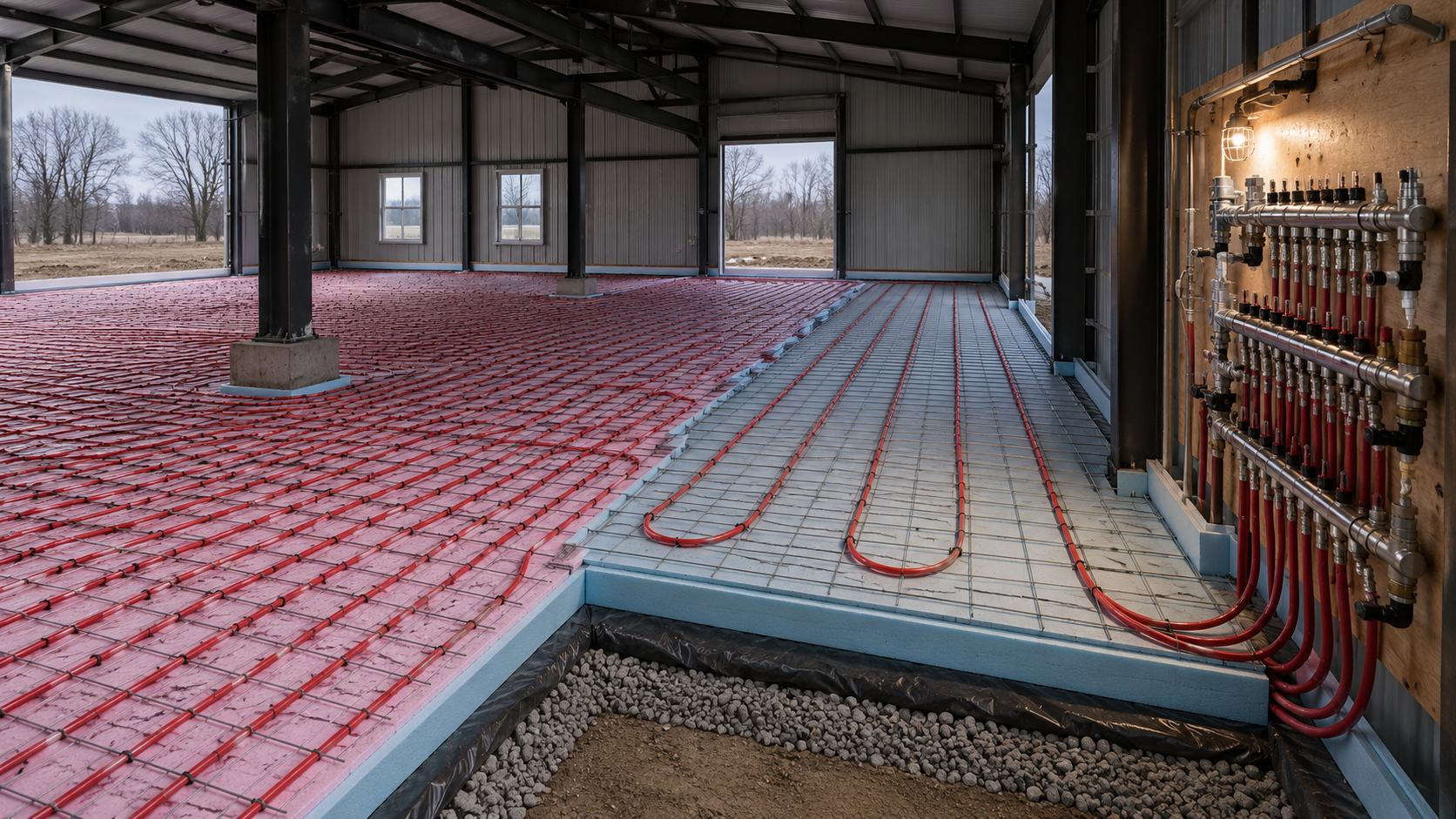
Tubing density tiers
| Tier | Spacing (planning) | Where | Goal |
|---|---|---|---|
| Comfort | 6–9" OC (tighter at perimeter glazing) | Living wing · ILS living/bed/bath · downstairs baths · primary circulation | Barefoot comfort, stable winter occupancy |
| Athletic / mid | 9–12" OC | Gym slab | Real comfort during use |
| Maintenance | 12–18" OC | South garage bays · ILS garage · hybrid receiving · lift/service | Slab tempering, dry storage, usable winter garage |
Three manifold clusters
- North manifold — ILS living/bed/bath, north quiet zone, upper north baths
- Central manifold (primary hub) — main mech room. Living wing comfort, gym slab, possibly UCR + upper living
- South manifold — workshop, WC, equipment, garage, hybrid, LOW above
Upper floor strategy
- Lightweight hydronic radiant + gypcrete (or equivalent) over wood floor framing
- Compatible with exposed ceiling philosophy below
- Calm baseline comfort — not primary HVAC response
Slab assembly (bottom → top)
- Compacted subgrade · stone base
- Underslab vapor barrier · rigid slab insulation (continuous)
- Reinforced concrete slab · hydronic tubing
- Finished slab surface
✅ Foundation cascade — withdrawn 2026-05-15 PM
Earlier draft warned of a "pier foundation cascade" risk. Per builder rebuttal, this was a misreading of architectural terminology. In a PEMB-residential context, "piers" = deep concrete pile footings under the steel column grid + grade beams. The slab itself remains a continuous monolithic slab-on-grade with integrated radiant tubing over continuous rigid insulation. No "wood subfloor on piers" assembly is contemplated. The radiant strategy in this LDD applies as written.
Execution rules
- Pressure testing before pour
- Tubing layout photographed and mapped before pour
- Manifold labels installed
- No undocumented tubing under slab
- No giant single-zone system — every zone independently controllable
Open items / engineer review
- Final tubing spacing per zone — Manual J / radiant load calc
- Slab thickness + reinforcement — coordinate with structural and geotechnical
- Underslab insulation R-value by zone
- Maintenance-zone target temperature
- Gypcrete decision: dead load impact, drying time, height transitions, acoustic
- Gym slab: athletic comfort vs maintenance only — pick one
Cost drivers
Tubing + labor $35–45K (~6,000 sqft slab, weighted avg). Manifolds $12–21K. Slab insulation $9–15K. Gypcrete upstairs $15–25K — biggest single cost lever. Total $90–125K.Air-gap concerns
- Two §11 sections in source LDD. Document was edited in pieces; needs cleanup pass.
- Bathroom comfort spacing not specified — typically 4–6" near showers, not 6–9" generic.
- Workshop classification wishy-washy. Pick comfort or mid; don't leave open.
- Gym slab strategy unresolved — locked at athletic comfort, options list contradicts.
- Bedroom radiant not addressed — only ducted is mentioned. Cold floor in winter is a regret.
- 85°F surface cap from LDD-24 flooring is a real constraint on operating curve.
Cross-references
Diagram
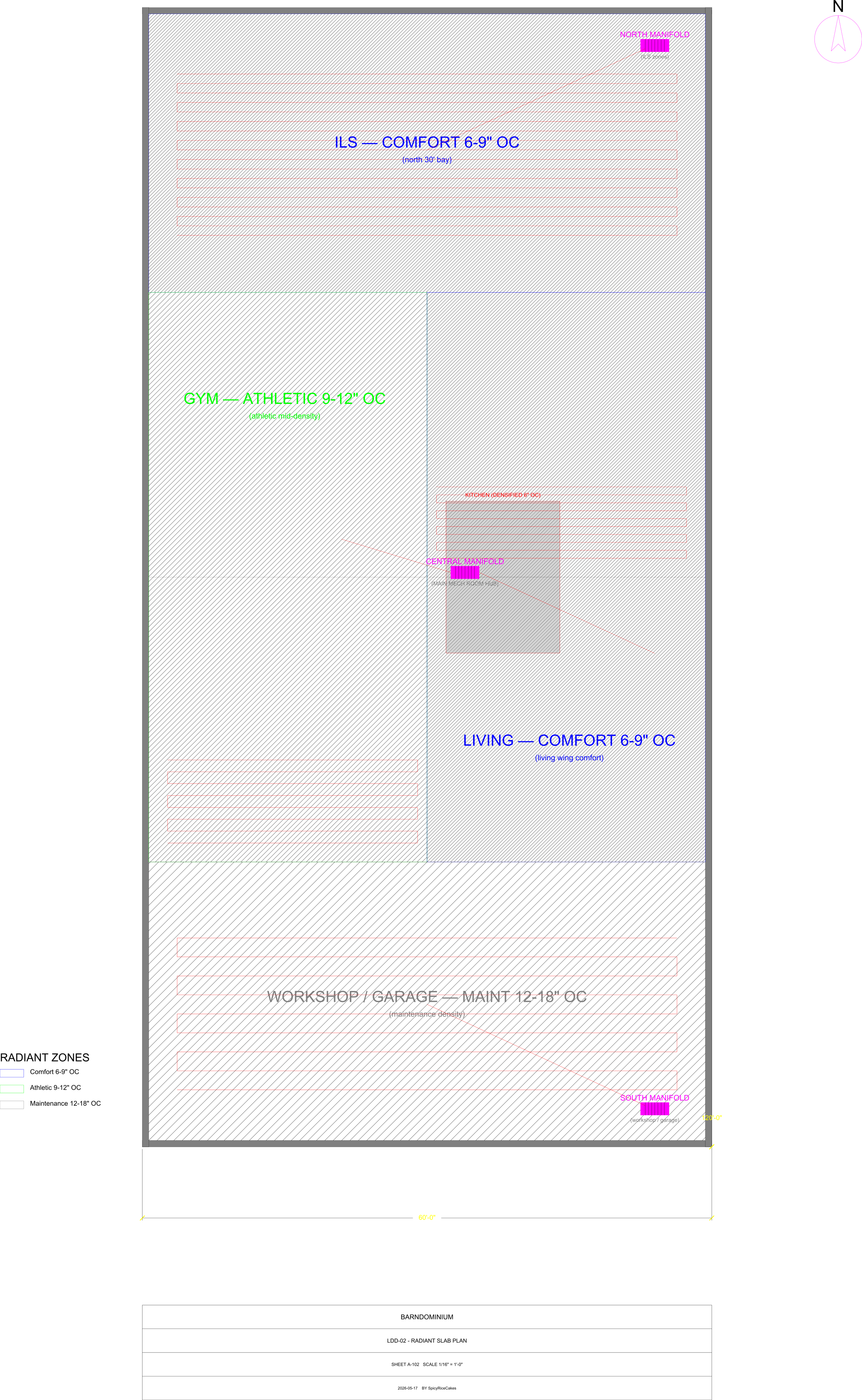
cad/source/02-radiant.py. Click to enlarge.