LDD-25 · North Gym Movement / Ballet Mirror Wall
Status: 🟡 DRAFT v0.1 — Peter's intent locked in, my analysis layer (costs + air-gaps) below. Awaiting first build-mockup before promoting to v1.0.
One-line intent
A legitimate ballet-studio-quality mirror + barre wall, recessed and acoustically dead, that doubles as the gym's atmospheric north face — calm and architectural by default, with a retractable protective net for chaotic athletic modes.
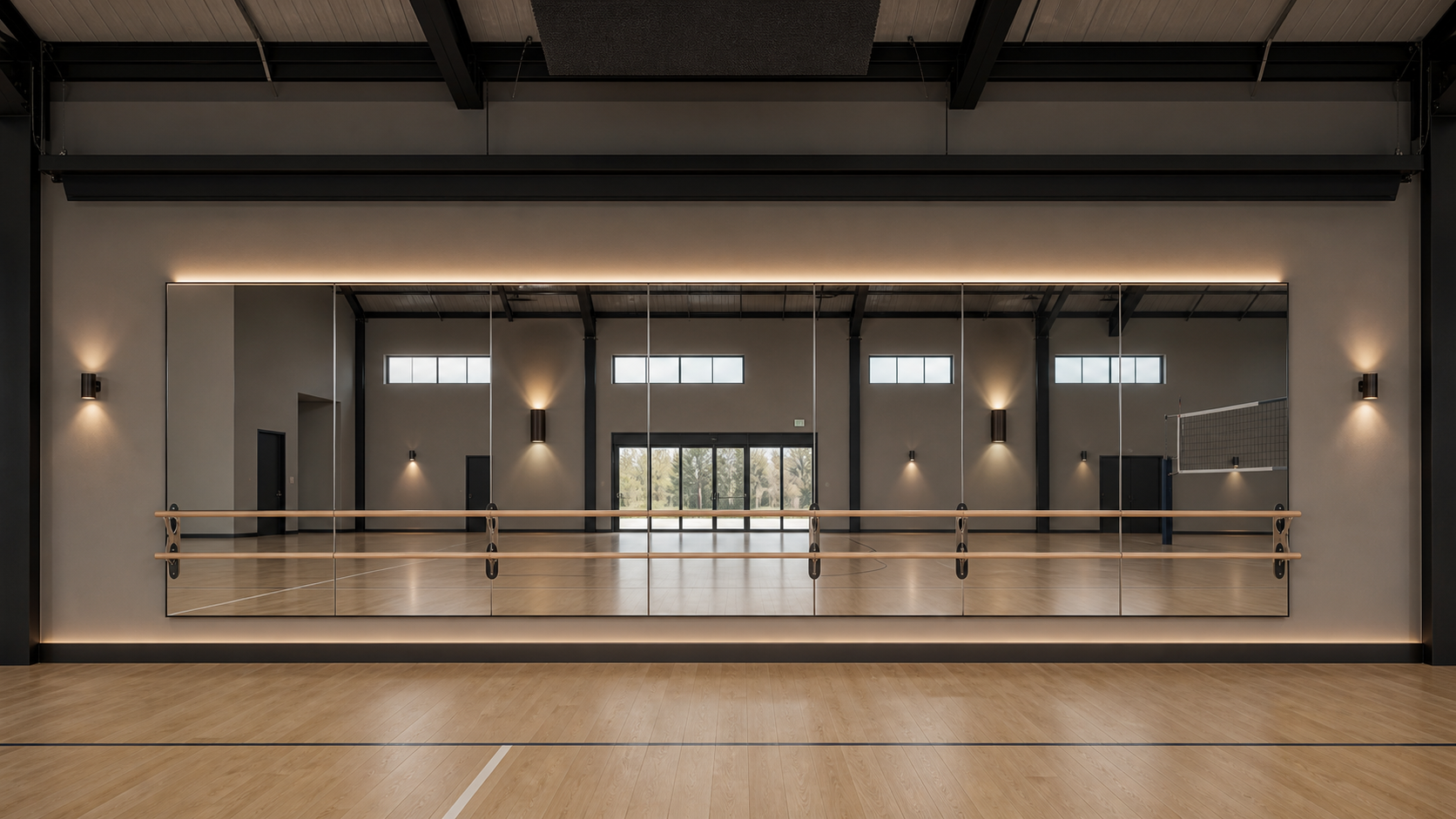
Design intent · AI render
⚠️ STALE detail — flagged 2026-05-17. The sliver of gym floor at the bottom of frame depicts the OLD spec (polished hardwood with a faint volleyball line). Per Peter's revised LDD-29 §25–§27 the gym floor is now matte poured-urethane in medium warm-gray with NCAA basketball + beach volleyball striping. Priority: LOW — gym floor is incidental at the bottom edge; the mirror wall is the subject. Update the inline prompt's floor line and regenerate via Codex when this render is next refreshed for any reason.
Why this matters
The gym needs a mirror wall to be a real movement room (ballet, mobility, yoga, posture) — not a "home gym with mirrors stuck up." Peter's framing is correct: this is integrated movement infrastructure, sibling to LDD-04 west gym hero wall and LDD-22 basketball hoop system. Get the wall logic + mounting + recess right and ballet, paddle sports, and warmups can all coexist on the same surface without the room ever reading as a school gym.
Locked decisions
Location + extent
- North wall of gym
- Overall architectural field ≈ 35' wide
- Primary mirror field ≈ 28' wide, centered within the 35' field
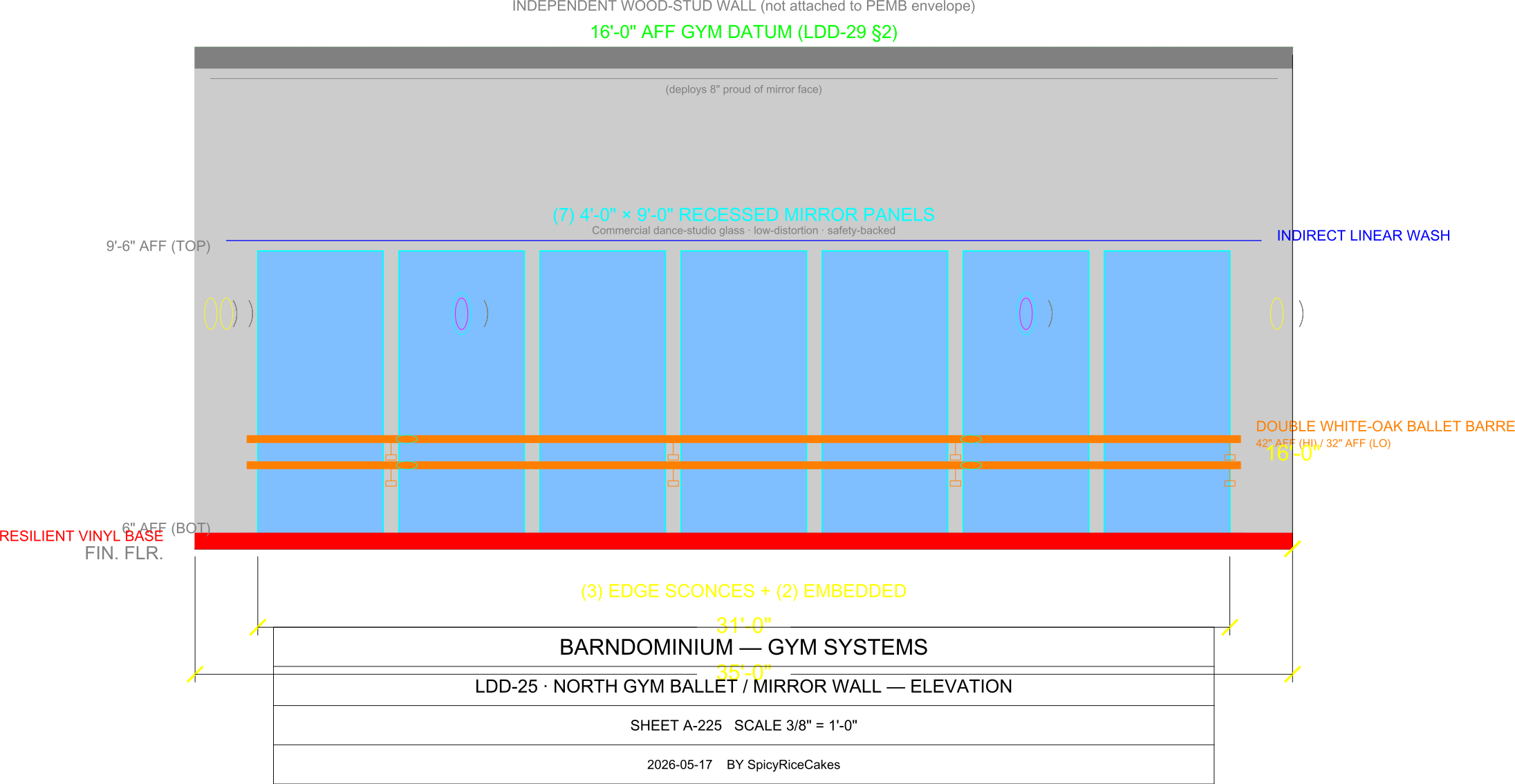
- 7 mirror panels (LOCKED INTENT)
Mirror panel system (LOCKED INTENT)
- Each panel ≈ 9' tall × 4' wide
- Mirror bottom ≈ 6" AFF, mirror top ≈ 9'6" AFF
- Commercial dance-studio-quality glass — low distortion, thick spec, safety-backed minimum
- Residential "home gym" mirrors prohibited
- Priority order: reflection accuracy → durability → safety → replaceability → visual calm
Mirror wall assembly (LOCKED INTENT)
- Independent wall — NOT mounted to PEMB envelope directly
- Wood-stud assembly, reinforced backing, plywood substrate, acoustic insulation
- Finished wall must feel dead solid — no visible flex or vibration
Recessed integration
- Mirror plane sits ¼"–½" recessed into the wall field
- Reads as architectural reflective insets, not applied mirrors
- Reveal provides edge protection, shadow line, serviceability
Retention + replaceability
- Concealed bottom-bearing support + hybrid concealed mechanical retention + controlled adhesive + silicone movement joints
- NOT adhesive-only mounting
- Single-panel replacement must be possible without damaging adjacent panels
- No visible mirror clips or commercial mirror hardware
Perimeter joints
- Minimal low-profile silicone movement joints, translucent or neutral
- Small controlled reveals preferred over zero-gap butt joints (absorbs tolerance, softens edge, reduces visible clutter)
Impact resilience
- Tolerates: normal athletic use, occasional volleyball, general gym activity
- Does NOT target: racquetball-grade impact, projectile-proof glazing, abuse-resistant institutional gym wall
- Protection comes from: robust mirror spec + recessed edges + rigid backing + deployable protective net (below)
Double barre system
- White oak preferred — tactile warmth, durability, replaceable
- Standard commercial dance-studio barre hardware (no custom artisan fabrication)
- Wall-mounted, double height
- Mirror panels include controlled oval cutouts/reveals at barre standoff points — avoids exposed hardware, preserves architectural continuity
Lower wall protection zone
- Below the 6" AFF mirror line: resilient vinyl base or impact-resistant material
- Concealed magnetic stabilization components for the protective net's lower bar (see below)
- Cleanable, edge-protected, operationally robust
Lighting strategy (overall)
- Indirect upper linear wash at upper wall / ceiling junction — soft downward wash, low glare, even mirror illumination
- 5 atmospheric sconces — composition relates to the 35' wall field, not the mirror spacing
- Outer sconces in the solid wall edge zones; selective embedded sconces within the mirror field using oval reveal geometry — restrained, small-scale, warm low glow
- Sconces secondary to overall mirror calm
Protective sports net (LOCKED INTENT)
- Retractable motorized athletic protection net above the mirror wall
- Deploys for paddle sports, futsal, high-chaos modes, adaptive sports
- Deployment plane ≈ 8" proud of mirror face (impact interception, not direct mirror covering)
- Cleanly retracts when not in use; preserves architectural calm
- Design language: dark neutral netting, taut, concealed upper housing, weighted lower bar — not school-gym curtain
- Magnetic stabilization at lower bar = positional aid only, light enough for smooth motorized retraction
Acoustic + atmospheric intent
- Calm, warm, disciplined, tactile, integrated into the gym
- Supports quiet nighttime atmosphere, layered reflections, movement awareness, social adaptability
Open items / requires engineer review
- Mirror system supplier + spec sheet — commercial dance studio mirror manufacturer (e.g. GlassCrafters, Mirage, or equivalent), with safety backing, thickness, and replaceability mechanism documented. Long lead times — order spec by start of construction.
- Independent wall structural attachment — wood-stud wall reads "free-standing" but must be braced laterally back to the PEMB frame at top + sides. Confirm with structural engineer the tie-back detail that preserves the "dead solid, non-vibrating" intent.
- Embedded sconce thermals — heat from sconces inside mirror cutouts must not damage mirror backing or fog the silver layer. Spec LED only; confirm housing isolation from mirror substrate.
- Net housing integration — the protective net's upper housing must integrate with the LDD-12 exposed ceiling hierarchy without becoming the project's first conventional soffit. Detail this carefully — it's the highest exception risk in the gym ceiling.
- Net motor + control — 35' retractable motorized net needs dedicated 20A circuit, low-voltage control, integration with the lighting scene system (LDD-08). Confirm motor noise spec (gym should remain quiet during deploy/retract).
- Cleanability of recessed reveals — ¼"–½" recess at mirror edge is a dust + moisture trap. Specify reveal detail that drains/cleans without disassembly.
- Magnetic stabilization vs net motor torque — the lower-bar magnets must be light enough to release cleanly when the motor retracts. Confirm pull-force during commissioning.
- Floor edge condition at mirror wall — the 6" AFF mirror line and the resilient base zone interact with the LDD-24 gym floor urethane finish. Coordinate base + transition detail.
Cross-references
- ← LDD-01 structural — independent stud wall braces back to PEMB frame at top and sides.
- → LDD-04 west gym hero wall — the paired long-edge gym wall; the two together set the gym's character.
- → LDD-08 lighting framework — linear wash + 5 sconces (3 wall, 2 embedded), scene-controlled with net deploy.
- → LDD-09 electrical — circuits for net motor + sconces + linear wash.
- → LDD-12 exposed ceilings — net upper housing is the highest-stake "no soffit" exception in the gym.
- → LDD-18 interior materials — white oak barre, mirror, resilient base — all material palette decisions.
- → LDD-22 basketball hoop system — sister gym infrastructure; backboard impact zone is the west wall, mirror is the north; the protective-net concept parallels.
- → LDD-24 flooring — gym urethane floor edge condition at the 6" AFF mirror line + base zone transition.
Cost drivers
Ballpark rollup at v0.1 — refine after supplier specs and mockup.
- Commercial dance studio mirrors (7 panels @ ~36 sf each, 252 sf total): $40–80/sf installed for the spec described (low-distortion, safety-backed, hybrid retention) = $10–20K. This is the line item with the widest range and the longest lead time.
- Independent wood-stud wall + plywood backing + acoustic insulation: $8–15K including framing labor, dense-pack or mineral-wool insulation, vapor strategy, reinforced backing zones.
- Double white oak ballet barre (commercial system, 35' run): $3–6K including hardware + standoff details + oval mirror cutouts.
- Retractable motorized protective net + housing + motor + lower bar + magnetic stabilization: $4–10K depending on motor spec and concealment quality.
- Lighting (linear upper wash + 5 sconces, 3 wall + 2 mirror-embedded): $1.5–3K fixtures + $1.5–3K labor.
- Recess detailing + silicone joints + base zone material: $1–2K.
Likely-case rollup: $30–55K for the complete wall (mirrors + wall + barre + net + lighting + finishes). Worst case if commercial mirror spec runs high and net is fully concealed: ~$60K.
This is a real cost — but it's one of the few moments in the project that defines the gym as a movement room rather than a shed. Treat it as a hero detail, not a finish line item.
Air-gap concerns
- Mirror supplier lead time is the schedule risk. Commercial dance studio mirrors are not commodities — they're often 6–12 week lead times for the safety-backed, low-distortion spec described. Lock the supplier + place order at the start of interior buildout, not at finish-out. Late mirrors become "we'll just install residential ones for now" — and the residential ones never leave.
- The "independent wall, not attached to PEMB" intent is structurally subtle. A free-standing wood-stud wall 35' long × 10' tall is not stable on its own; it MUST tie back to the PEMB frame somewhere. The intent is acoustic + vibration isolation, not literal structural independence. Detail the tie-back as a flexible/damped connection (rubber isolators, slip joints) so vibration doesn't transfer from PEMB to mirror — but the wall doesn't fall over.
- The "single panel replaceable without damaging adjacent" claim needs vendor verification. Many commercial mirror systems use J-channel top retention which makes single-panel replacement possible but only top-down (the panel slides up and out). Peter's "concealed bottom-bearing + adhesive hybrid" needs an actual installed system that demonstrates this — get the supplier to confirm in writing or demo on a mockup.
- Embedded sconces inside mirror panel cutouts are the riskiest sub-detail. Mirror backing + heat + moisture = silver oxidation = black halos around the sconce within a year. Spec: low-heat LED only, sconce housing fully sealed from the mirror cutout edge, mirror backing protected behind the cutout edge with a moisture barrier. If unclear, drop the embedded sconces and put all 5 on the solid wall edges.
- The "8" proud of mirror" deployable net spec needs reality testing. 8" standoff is enough to absorb light volleyball but probably not enough to absorb a hard paddle-sport serve into the net. Build a mockup or get manufacturer impact data before locking 8". If 8" turns out to be insufficient, the housing has to be deeper, which affects the ceiling integration with LDD-12.
- Operational risk: people will forget to deploy the net. A motorized retractable net that requires a button push is fine if people remember. Build the safety net into the gym's lighting/mode system — e.g., "paddle sport mode" lighting scene auto-deploys the net. Otherwise plan for a mirror-replacement budget every 3–5 years from forgotten net-down sessions.
- Volleyball impact spec is loose — "tolerate occasional volleyball impacts" is not a code spec. The commercial dance mirror is rated for no direct impact; safety-backing prevents shatter, not breakage. If volleyball is actually expected to hit the mirror without the net deployed, the wall fails its own intent. Either tighten the rule ("net up for any ball sport") or test impact tolerance on the actual mirror panel before committing.
- The "calm architectural wall" intent vs. the protective net's deployed state is a hard mode-switch. When the net is deployed, the wall reads as athletic equipment. That's fine — but it means there are two architectural states (calm + deployed) and both need to feel intentional. Test how the deployed net looks at night with the embedded sconces on. If it looks like a school-gym curtain in any lighting condition, the net design language has failed.
Diagram
Status
🟡 Yellow — DRAFT v0.1. Intent is clear and disciplined; the air-gap list above is the path to v1.0. Highest-priority next steps: (1) source a commercial dance studio mirror supplier and lock spec, (2) detail the independent wall tie-back to PEMB, (3) mockup the embedded sconce cutout to test mirror-backing thermal/moisture risk.