LDD-26 · South Gym Rebound + Acoustic Wall
Status: 🟢 LOCKED v1.0 — Peter's spec is internally consistent and disciplined. Air-gap items below are pre-construction reconciliation, not v1.0 blockers.
One-line intent
Calm athletic infrastructure: a two-zone south wall that takes ball impacts down low and absorbs reverb up high, all in the gym's restrained industrial language.
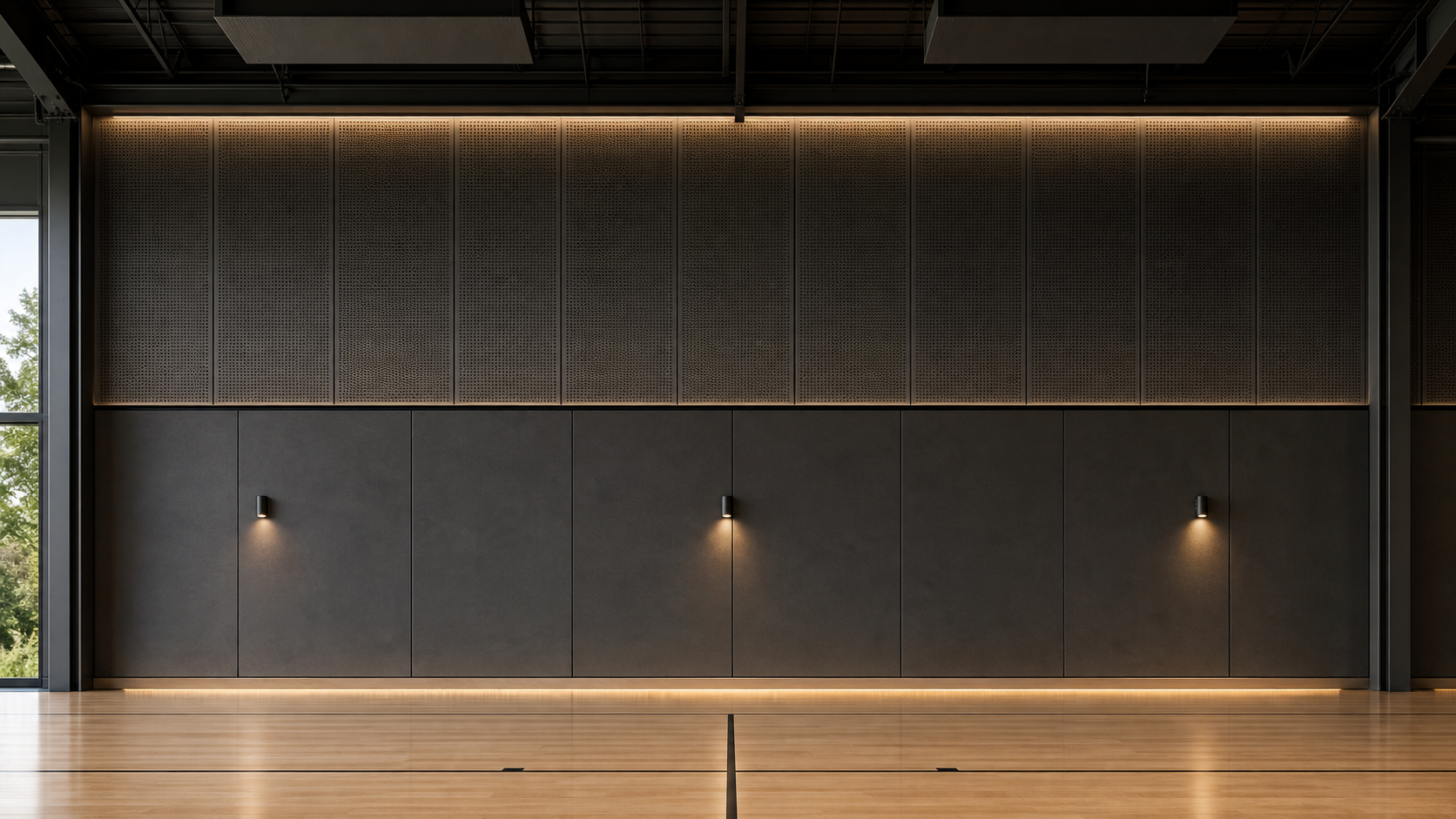
Design intent · AI render
⚠️ STALE detail — flagged 2026-05-17. The sliver of gym floor at the bottom of frame depicts the OLD spec (polished hardwood with a faint volleyball line). Per Peter's revised LDD-29 §25–§27 the gym floor is now matte poured-urethane in medium warm-gray with NCAA basketball + beach volleyball striping. Priority: LOW — gym floor is incidental at the bottom edge; the rebound wall is the subject. Update the inline prompt's floor line + palette "warm white-oak hardwood floor" mention and regenerate via Codex when this render is next refreshed.
Why this matters
The gym needs a south face that earns its keep three ways at once — takes a beating, kills the upper-volume echo, and stays visually calm. Get this wrong and the gym either feels like a school gym (institutional, harsh, echoing) or like a fragile architectural set piece that breaks under real use. Peter's two-zone strategy (rebound low / acoustic high) is the right framework: it does each job in the zone best suited to it, and the lighting language ties it back into the unified gym perimeter.
This is the paired sister wall to LDD-25 north gym ballet wall. Together they bracket the gym between the LDD-04 west gym hero wall (clerestory) and the LDD-03 spine wall (gym/living boundary).
Locked decisions
Two-zone organization (LOCKED)
| Zone | Height | Purpose |
|---|---|---|
| Lower athletic rebound | floor → ~16' AFF | Controlled impact + rebound + abuse tolerance |
| Upper acoustic moderation | ~16' AFF → ceiling | Reverberation reduction + visual softening |
Lower athletic rebound zone
- Behavior target: lively but moderated rebound, satisfying athletic response, controlled ricochet, reduced harsh slap echo
- Tolerates: volleyball, incidental futsal, general athletic and adaptive sports use
- Does NOT target: repeated basketball rebound drills, racquetball-grade abuse, projectile-resistant use, professional rebound-training infrastructure
- Assembly direction: plywood-based impact panel system + robust backing + controlled cavity behavior + concealed fastening where practical
- Prohibited: fragile MDF-only systems, institutional FRP aesthetics, exposed chaotic panel systems, glossy sports-wall finishes
Lower wall finish (LOCKED)
- Soft charcoal color
- Matte or low-sheen finish — glare-controlled, ball-visible, hides wear
- Prohibited: bright white, saturated athletic colors, glossy polyurethane gym aesthetics
Lower abuse strategy
- No separate visible kick-strip — consistent visual system across full lower height
- Durability comes from coating spec + touch-up-friendly paint, not visual segmentation
Panelization
- Disciplined modular layout, rhythm aligned with PEMB structural order + gym architectural hierarchy + lighting composition
- Prohibited: arbitrary rhythms, checkerboard sports aesthetics, chaotic joint layouts
Upper acoustic moderation zone
- Function: acoustically absorptive architectural field — reduce upper-volume reverberation, soften visual scale, support atmospheric lighting
- Material preference: inexpensive mineral-wool acoustic panel system — strong NRC per dollar, simple install, serviceable
- Visual intent: recessive, calm, integrated — no recording-studio decorative aesthetics, no exposed foam, no busy acoustic graphics
Transition datum at ~16' AFF (LOCKED)
- Restrained horizontal datum between lower rebound and upper acoustic zones
- Strategy: subtle shadow-gap datum (no decorative trim)
- Reinforces disciplined horizontal order; reads as architecture, not as a wainscot or chair rail
Lighting integration (unified with broader gym perimeter)
- Same three-layer hierarchy used on all major gym walls:
- Upper indirect linear — concealed at wall/ceiling junction, soft downward wash, atmospheric perimeter glow
- Wall sconces at human-scale datum — extremely small, low-profile, matte aluminum or steel, restrained
- Low-level indirect linear — concealed source near floor, reads as reflected glow not visible LED strip
- All layers warm, low-glare, dimmable, scene-controlled
Hidden future infrastructure
- Concealed anchor points + hidden mounting provisions integrated into the wall composition during construction
- Purpose: future adaptability without retrofit demolition
- Visually unobtrusive during normal operation
Maintenance + serviceability
- Touch-up-friendly paint spec
- Durable finishes that survive 50-year build
- Straightforward repair conditions — no high-custom detailing
Open items / requires engineer review
- Acoustic absorption target (NRC) not specified. "Mineral wool panel" covers a 0.65 → 0.95 NRC range depending on density, thickness, and facing. Pick a target (e.g., NRC ≥ 0.85 for the upper zone) and let that drive the spec — otherwise the cheapest panel buys cheap acoustic results.
- Lower-wall coating selection. "Touch-up-friendly paint" + "tougher lower-wall coating" can be at odds — industrial coatings (epoxy, urethane) don't always touch up cleanly because the new patch flashes against the cured field. Pick one spec or accept that touch-ups will be visible.
- Plywood-based impact panel system supplier. Specify the panel system (e.g., thickness, layer-up, edge profile, fastener pattern). "Plywood-based" is a direction, not a product.
- Mineral wool facing. Exposed mineral wool will be punctured by errant balls and degrade visually within months. Specify the facing (acoustically-transparent fabric, perforated metal scrim, or microperf board) and confirm it's rated for ball impact at 16'+ AFF.
- Shadow-gap datum dimension + detail. "Subtle" needs a number — typical shadow gap = ¼" to ¾". Detail with the upper-zone bottom edge return + lower-zone top trim so the gap reads continuous around the 35' wall length.
- Hidden anchor point grid. What loads do they need to take (climbing holds, future pull-up rigs, future basketball winch retrofit, projector screens)? Specify the grid spacing + the substrate behind the lower panel system that can take fasteners.
- PEMB girt coordination. Plywood-based impact panel system attaches to PEMB girts — confirm girt spacing matches the desired panel module, and that the girts are spec'd for athletic impact loads (most PEMB girts are sized for cladding, not for someone running into them).
- Coordination with LDD-04 west gym hero wall clerestory. The west wall's clerestory ends at some height — does the south wall's 16' transition datum align with the bottom of the clerestory, or with a different gym horizontal? Aligning them gives the gym a single horizontal datum; misaligning makes the room feel busy.
Cross-references
- ← LDD-01 structural — lower rebound panels attach to PEMB girts; girt spec must accommodate athletic impact loads.
- → LDD-04 west gym hero wall — adjacent gym wall; clerestory bottom should coordinate with the 16' AFF transition datum if possible.
- → LDD-08 lighting framework — unified gym perimeter lighting: upper linear + sconces + low-level linear.
- → LDD-09 electrical — circuits for all three lighting layers.
- → LDD-12 exposed ceilings — upper acoustic zone meets ceiling hierarchy at the top; the acoustic panel system must integrate cleanly with the exposed structure above.
- → LDD-18 interior materials — soft charcoal palette, plywood impact panel finish, mineral wool acoustic system.
- → LDD-22 basketball hoop system — hoop is on the west wall; this LDD explicitly does NOT target basketball rebound drills.
- → LDD-23 build rules — panelization rhythm follows PEMB structural order per the constraint discipline.
- → LDD-24 flooring — base condition + transition at floor edge.
- → LDD-25 north gym ballet wall — paired sister wall; together they define the gym's calm-vs-athletic mode balance.
Cost drivers
This is the cheapest of the four gym walls — the spec is intentionally cost-effective.
- Lower rebound zone — plywood impact panel system (~16' × 35' = 560 sf): $15–25/sf installed including framing, blocking at impact zones, fastening, soft charcoal coating = $8–14K. Plywood-based commercial gym panel kits run lower than custom assemblies.
- Upper acoustic moderation zone — mineral wool with acoustic-transparent facing (~10' × 35' = 350 sf at typical 26' ceiling): $10–20/sf installed = $3.5–7K. The "inexpensive mineral wool" call keeps this in the low-end-acoustic range; faced panel systems (e.g., Tectum, fabric-wrapped mineral wool) at the cheap end.
- Shadow-gap datum detail at 16' AFF: $0.5–1.5K trim/labor for the 35' run.
- Lighting (one wall's share of the unified three-layer gym perimeter): $2–4K fixtures + $1.5–3K labor for upper linear, ~3 sconces, low-level indirect.
- Hidden anchor provisions (blocking + fastener-rated substrate): $0.5–1K — incremental during framing.
- Touch-up-friendly coating spec premium (over standard wall paint): negligible if specified up front; $1–2K if upgraded after the fact.
Likely-case rollup: $16–30K for the complete wall.
For comparison: LDD-25 north ballet wall is $30–55K. The mirror wall does more (mirrors + barre + protective net + embedded sconces); the rebound wall is genuinely cost-effective infrastructure. The asymmetry is intentional.
Air-gap concerns
- The "inexpensive mineral wool" call is fine IF acoustic targets are specified. Mineral wool from 1" to 4" varies hugely in absorption. Without an NRC target and a specific frequency band (gym noise is often mid-band, 500 Hz–2 kHz), the cheapest panel might absorb 0.5 at the target frequency — not enough to actually moderate gym reverberation. Lock NRC ≥ 0.85 minimum for the upper zone and let that drive material thickness + density.
- Mineral wool needs a ball-tolerant facing. Bare or even fabric-wrapped mineral wool will be punctured by errant balls eventually, even at 16'+ AFF. Spec a perforated metal scrim, microperf board, or rigid fabric facing rated for impact. The "cheapest mineral wool" should NOT mean exposed wool.
- Plywood impact panels need real athletic impact validation. Commercial gym plywood panel kits exist (e.g., Connor Sports, Robbins) — but they're sized for sport floors, not walls. Pick a wall-rated impact panel system or detail a custom plywood-on-blocking assembly with the framing engineer. "Plywood-based" + "robust backing" is direction, not spec.
- PEMB girt impact loading is not standard. PEMB girts are typically sized for cladding wind loads (~25–35 psf design pressure). Athletic ball impact is a localized peak load (a hard volleyball can deliver ~50–100 lbf concentrated). Either spec a stiffer girt at the lower zone or add secondary blocking. Catch this in the PEMB order, not in the field.
- Touch-up paint + tough coating is often a contradiction. Industrial-grade gym wall coatings (epoxy, urethane) are hard and abrasion-resistant but they don't accept touch-ups cleanly — the patch flashes and looks worse than the dent. Either (a) pick a satin/matte acrylic that touches up well but accept that it'll wear faster, or (b) pick the hard coating and accept that maintenance means re-coating a panel section, not touching up.
- The 16' AFF datum needs a horizontal-alignment audit. Verify that the 16' transition lines up with the west gym hero wall's clerestory bottom, or with another major gym horizontal (window head, mezzanine edge from LDD-13). If it doesn't, the gym gets two competing horizontals and the disciplined calm intent slips.
- "Hidden future infrastructure" must be detailed NOW, not deferred. Concealed anchor points only exist if blocking + fastener-rated substrate is installed before drywall/panels go up. Decide today: minimum grid spacing (4' × 4'? 2' × 2'?), load rating (50 lbs? 500 lbs?), and substrate type. Otherwise this LDD's "future flexibility" promise is theoretical — and 5 years from now a homeowner trying to mount a pull-up rig will discover there's nothing to bolt to.
- Charcoal matte wall + ball visibility tradeoff. Soft charcoal hides scuffs and reduces glare — but it also reduces ball contrast for some sports (volleyball + futsal balls are often white/yellow; charcoal background is fine for those). Confirm with a paint chip + a ball in the actual lighting before locking the LRV (light-reflectance value). If LRV is too low (< 10), the wall reads as a void at night and ball tracking suffers.
- Asymmetry with LDD-25 north wall is the design intent — but it bears stating. North wall = mirror + calm + recessed glass surface, vibration-isolated. South wall = plywood + rebound + acoustic, attached to PEMB. These two walls have opposite philosophies (isolated/calm vs. attached/active). This is correct for their functions, but verify the gym reads as a coherent room, not two halves of different rooms. Test by standing in the center and looking at both walls in the same field of view.
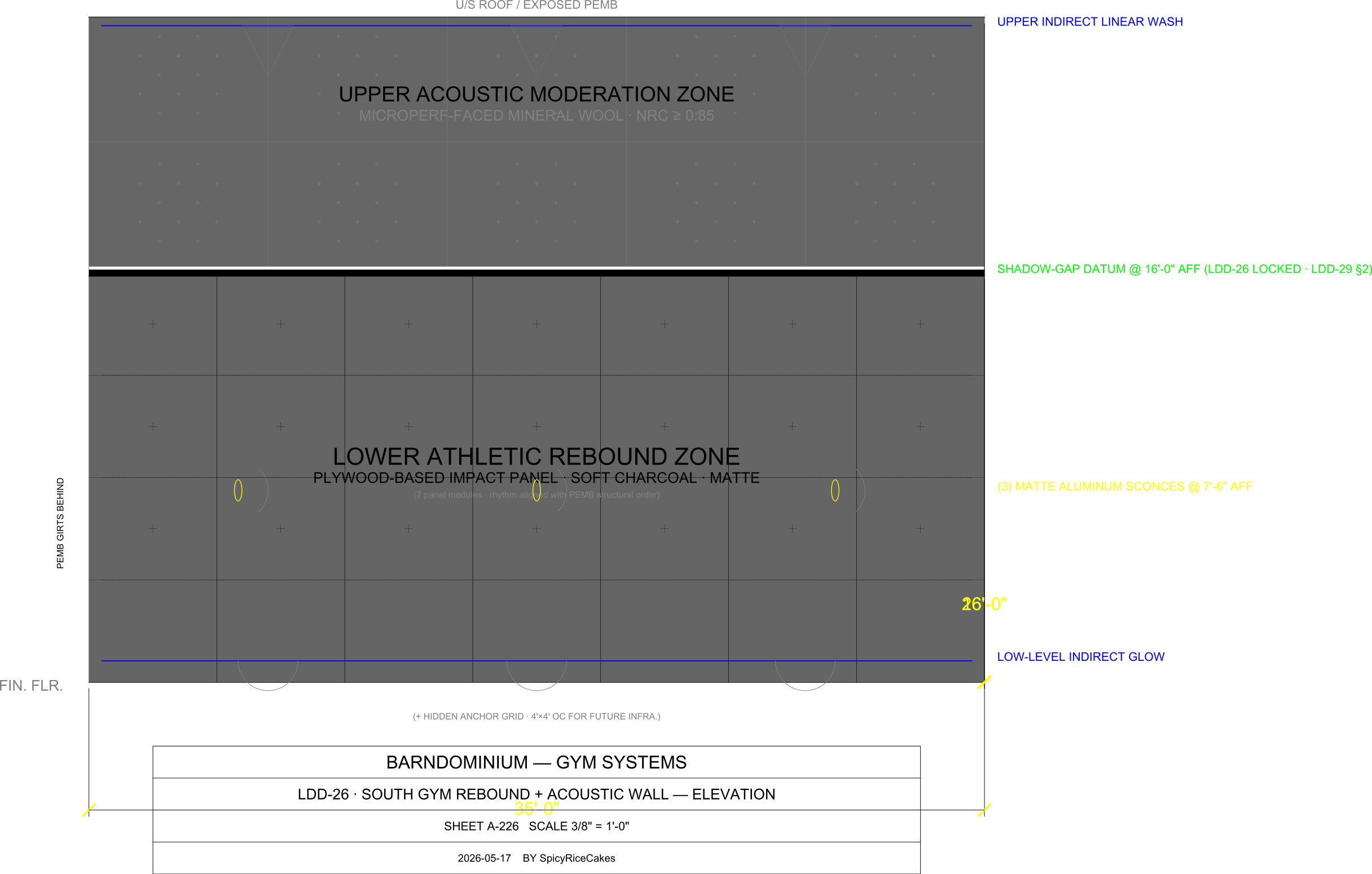
Diagram
Status
🟢 Green — LOCKED v1.0. Spec is internally consistent and the two-zone strategy is sound. Air-gap items above are pre-construction reconciliation (acoustic NRC target, coating selection, future-anchor grid) — none change the v1.0 design intent. Highest-priority follow-ups before bidding: (1) lock NRC target for upper zone + select faced panel system, (2) confirm PEMB girt spec at lower zone, (3) document the hidden-anchor grid.